

Events
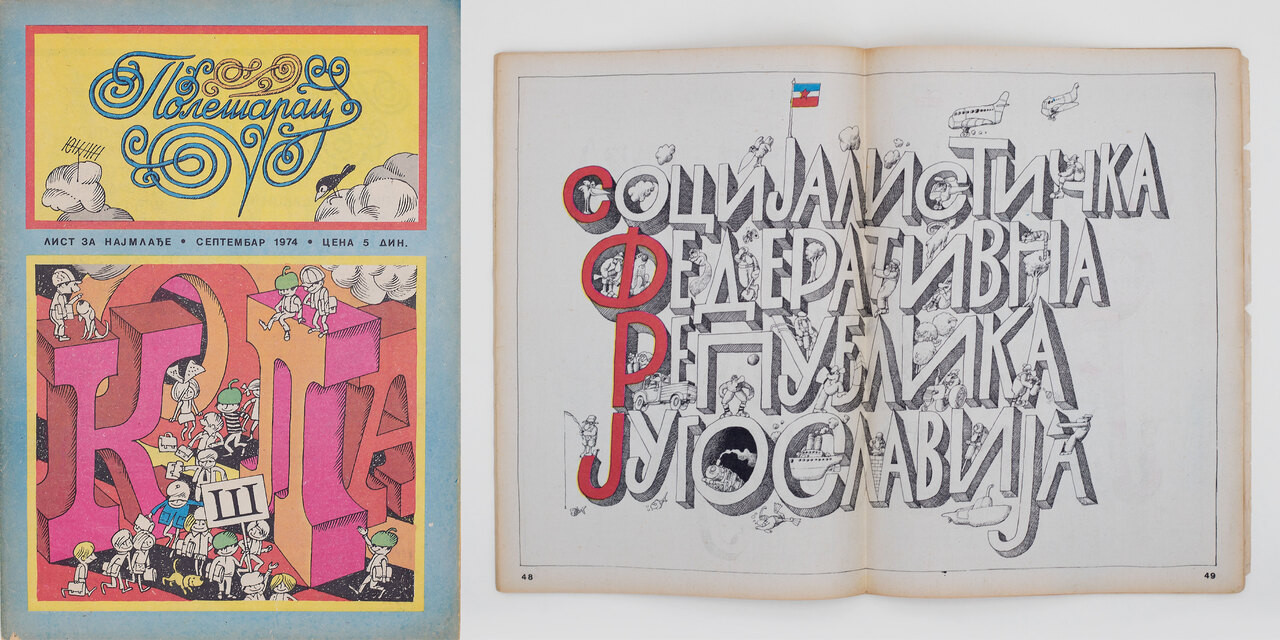
Poletarac: Lettering and Artistic Practices for Children in Socialist Yugoslavia
with Irma Puškarević
Discover Poletarac – the children's magazine where Yugoslav artists used lettering to ignite imagination and emancipate young minds.
- Date
- Time
Poletarac (Fledgling) was a two-year experimental publishing project for children, established through a collaboration between the socialist government of Yugoslavia and its cultural workers. Published from 1973 to 1975, the magazine brought together artists, illustrators, and authors to create imaginative worlds through text and image.
This lecture examines the magazine’s visual language as a tool for literacy, education, and the emancipation of children. Through an analysis of primary sources and editorial notes, the lecture demonstrates how lettering in Poletarac moves fluidly between image and text through both conventional and experimental artistic techniques. Central to the discussion is the magazine’s treatment of Cyrillic and Latin scripts — both officially recognized by the state — as equal and coexisting writing systems. Here, the alphabet emerges not only as a tool of literacy, but also as a site where cultural identity and artistic experimentation converge.
The lecture considers what this underexplored yet regionally beloved magazine reveals about the emancipatory potential of letterforms when art, education, and politics intersect.
Letterform Lectures are a public aspect of the Type West postgraduate program. The series is co-presented by the San Francisco Public Library, where events are free and open to all.
Irma Puškarević
Irma Puškarević is a researcher, educator, and practice-based artist whose work sits at the intersection of print culture, typography, and history, with a particular focus on Southeast European region. Her research is focused on uncovering cultural production from a region shaped by competing imperial legacies, multilingual landscapes, and the coexistence of multiple scripts. Through her long-term research project Letterform Network, Puškarević is developing a modular digital infrastructure for Southeast European typography and print culture heritage creating connective tissue across scattered collections and making fragmented historic material discoverable across the region. The project maintains a particular interest in surfacing the work of women, social minorities, and print artefacts that sit between disciplines.
Her practice is grounded in the understanding that knowledge is always situated, produced from a particular place, body, and history.
As an educator, she is invested in critical pedagogy, bridging research and applied learning to foster curiosity, critical thinking, and intellectual risk-taking in her students.